
By the GCCVest Team — GCCVest Insights
Turner & Townsend — the global construction consultancy whose Data Centre Construction Cost Index is one of the most widely cited construction cost benchmarks for the sector — has published its tenth edition, covering 62 markets and benchmarked against more than 500 live or recent projects. It lands at a remarkable moment: capital expenditure on data centers is already running at roughly US$800 billion a year and is projected to reach US$1.8 trillion by 2050, making digital infrastructure one of the largest construction programs in human history.
Most readers will scan the index for one number: what a watt costs where they build. We read it for two other things. The first is scattered through its tables and survey data: the clearest evidence yet that the economics of AI infrastructure are drifting toward the Asia–MENA corridor, from both ends at once. The second is what the index leaves out.
That second point matters more each year, because the established hubs are filling up. Singapore has allocated new capacity sparingly since its 2019 moratorium. Johor, the overflow market that debuts in this edition, has stopped approving the more basic Tier 1 and Tier 2 facilities because of pressure on water supplies. In the West, the index itself lists grid connections and planning consent as the top schedule risks. Builders are widening their search as a result, and the markets worth a serious look now extend beyond the 62 covered by Turner & Townsend. Morocco is one of the more notable omissions. It has no line in Turner & Townsend’s tables and rarely makes an operator’s first-round shortlist, yet more than a gigawatt of planned AI capacity has now been announced there.
The Watt Ladder
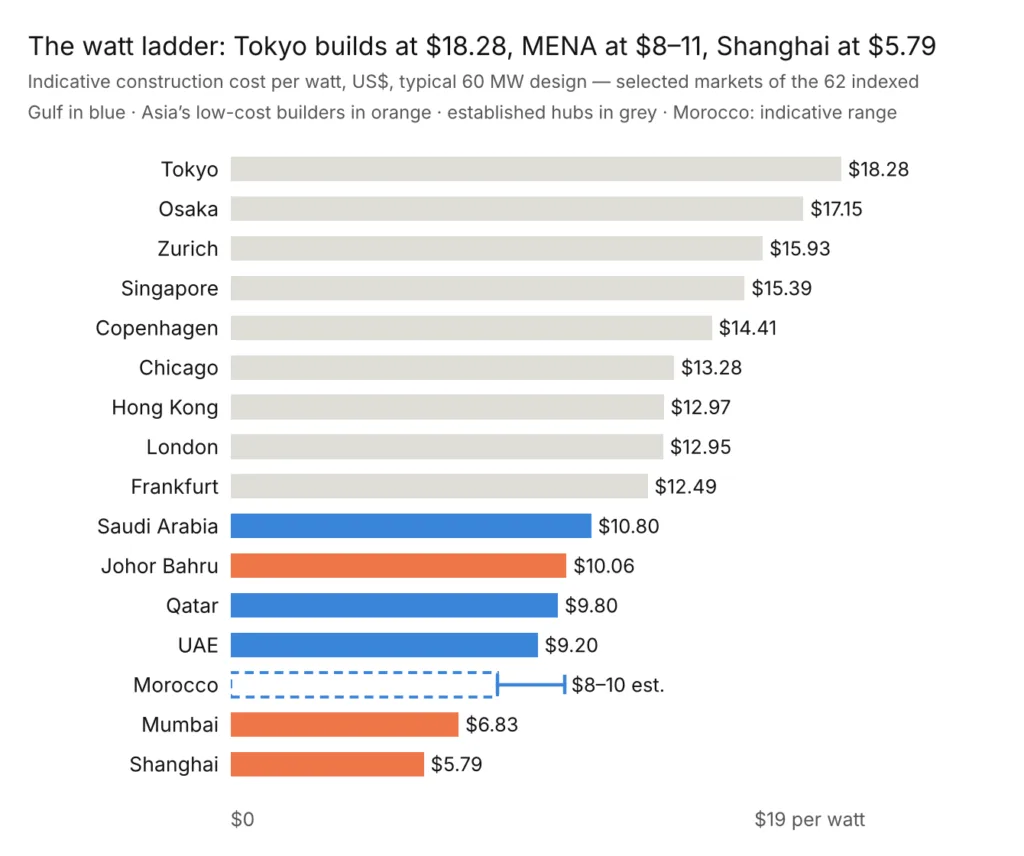
*Note: Indicative range for Morocco is based on data shared with us by AMDIE (Moroccan Investment and Export Development Agency) and our team’s own estimate. AMDIE’s developer benchmark of US$9–11/W includes professional fees, which Turner & Townsend excludes; the chart therefore shows the like-for-like range of ~US$8–10/W.
Source(s): Turner & Townsend, Data Centre Construction Cost Index 2026–27; AMDIE; GCCVest analysis
The spread is the story. A watt of capacity that costs US$18.28 to build in Tokyo costs US$10.80 in Saudi Arabia, US$9.80 in Qatar (a new entrant to the index this year), US$9.20 in the UAE, and a like-for-like US$8–10 in Morocco*. MENA builds at roughly half the cost of North Asia’s premium hubs and 15–30% below London, Frankfurt and Chicago. The index now ranks the Middle East as the cheapest region in the world to build, at an average of US$9.93 per watt against US$12.06 in North America, US$12.10 in Asia and US$12.76 in Europe. At the very bottom of the table sits the corridor’s other terminus: Shanghai, the cheapest of all 62 markets indexed, with Mumbai just above it. The world’s most expensive place to build digital infrastructure and its cheapest are both in Asia. The Gulf sits in the band where cost advantage meets sovereign-grade power and capital, and on the data now available, so does Morocco.
A note on the Morocco bar, and how we built it. Morocco is not among the 62 markets Turner & Townsend indexes, so the hollow bar is not an index figure. Our initial estimate, about US$10.50 per watt, was built from peer markets. The index’s African markets cluster tightly (Nairobi US$10.03, Johannesburg US$10.62, Cape Town US$10.70, Lagos US$10.87) because the largest cost components of a data center, its electrical and mechanical systems, are globally priced equipment. We have since tested that estimate against Moroccan data: The Moroccan Investment and Export Development Agency (AMDIE) shared with us an indicative construction cost range of US$9–11 per watt, provided by a developer currently building an AI data center in Morocco, which serves as an indicative market benchmark, not an official national reference. As mentioned in the above notes, the estimate includes professional fees which are excluded in the Turner & Townsend calculations, so the like-for-like Morocco figure is approximately US$8–10/W — the basis we use in the chart and in all comparisons in this piece.
The Divergence
A snapshot understates the case; the direction of travel makes it. The index shows North American and European cost-per-watt up 13% year on year — double the global average — while Saudi Arabia’s indicative cost actually fell between editions, sliding down the expensive-markets table from 18th to 40th. MENA is getting relatively cheaper while the West gets more expensive, which is the opposite of what a maturing-market story would predict — unless capacity, not cost, is the binding constraint in the West.
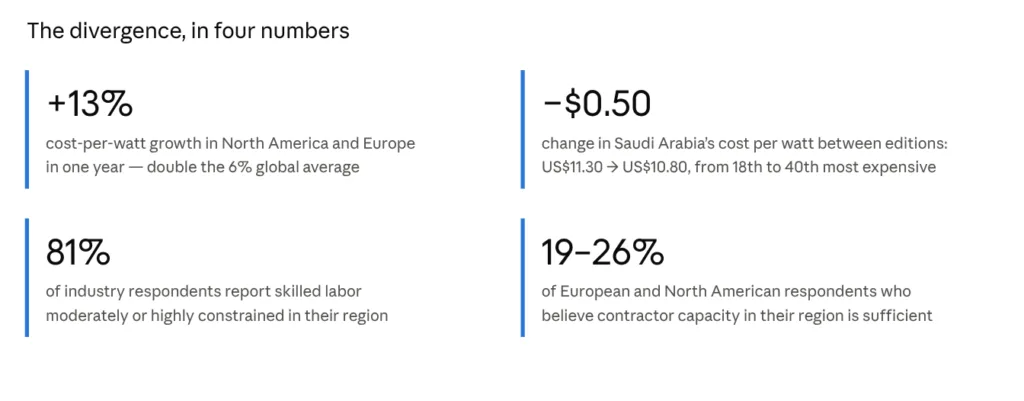
Source(s): Turner & Townsend DCCCI 2026–27 survey and index; Saudi prior-year figure from the 2025–26 edition’s regional release
The survey backs this up. The problems slowing down projects in the West aren’t about money. 81% of people surveyed say skilled workers are in short supply. Data centers are harder to find contractors for than any other type of construction. The biggest causes of delays are getting connected to the power grid, getting planning approval and changes to the design. The report’s most surprising finding is that building bigger no longer means building cheaper per watt; at gigawatt scale, costs can actually go up. In short, the West has the money, but it is running out of power, permits and people.
The Corridor Logic
Put the ladder and the divergence together and a structural trade comes into view, the same one we described in our Global Innovation Index analysis, now in concrete and copper.
MENA solves, by design, exactly what throttles the West. Run down the report’s list of Western bottlenecks and score MENA model against it: grid connections (state-owned utilities with sovereign mandates and energy to spare); planning consent (national AI strategies with fast-track authority); land (abundant, zoned, government-allocated); capital (the sovereign balance sheets now underwriting gigawatt campuses); labor mobility at scale (the construction model that built the giga-projects). The one Western constraint MENA does not escape is the specialist layer: mature data-center supply chains, MEP and electrical trades, liquid-cooling equipment, experienced delivery leadership.
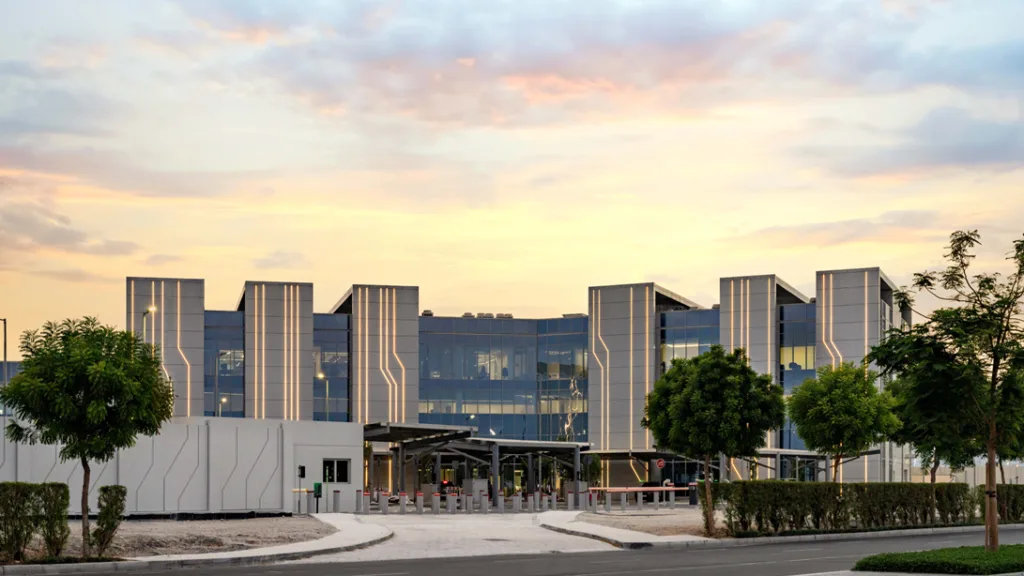
Khazna Data Centers: The largest hyperscale data center provider in UAE
And that is precisely what Asia has in surplus. Shanghai sits at the bottom of the index at US$5.79 per watt not because it cuts corners but because China has industrialized data-center delivery the way it industrialized everything else : deep contractor ecosystems, equipment manufacturing at scale, and engineering talent in volume. The corridor trade writes itself: MENA supplies power, land, capital and speed of consent; Asia supplies the conversion capability that turns those inputs into commissioned megawatts. Every Asian contractor, cooling manufacturer and cloud operator localizing in Riyadh or Abu Dhabi is importing exactly the capability layer MENA lacks , and the index even shows how fast that gap closes once it starts: Lagos entered the index as the 7th most expensive market and fell to 42nd in two years, at US$10.87, as supply chains matured and the local specialist talent pool expanded. That is the curve MENA is now riding but with far deeper capital behind it.
The report’s new entrants tell the same story from the Asian end. Johor Bahru debuts at US$10.06 per watt, as Singapore’s low-cost hinterland absorbing the capacity the city-state (US$15.39, 4th globally) can no longer price or power. It is the pattern we have described before in this series: a premium hub paired with a lower-cost build market next door. Singapore has Johor. MENA’s version of that pairing is taking shape across MENA, and North Africa is a natural candidate for the role. As the next section shows, however, the case there rests less on build cost than on power, land and location.
The Overlooked Market: Morocco
Morocco is the market most often missing from this conversation. It has little delivered hyperscale capacity, no line in the index, and it is seldom the first name on an Asian operator’s list. Yet on the factors the index says now decide where capacity gets built (cost, power, land, consent and people), it deserves a closer look than it usually gets.
On construction cost, Morocco is competitive rather than cheap. At a like-for-like US$8–10 per watt, it sits in the same band as Saudi Arabia (US$10.80), Johor (US$10.06), Qatar (US$9.80) and the UAE (US$9.20), and alongside the African cluster led by Nairobi and Lagos. At the midpoint, that is roughly 40% below Singapore, half the cost of Tokyo and about 30% below London and Frankfurt. It will not undercut Shanghai or Mumbai, and on build cost alone it offers no clear advantage over MENA. The reason is structural: electrical and mechanical systems account for the majority of a data center’s construction budget (AMDIE’s consultation puts electrical infrastructure alone at 40–45% of construction capex and mechanical and cooling at a further 15–25%, against 15–20% for building and civil works), and much of that equipment will be imported into Morocco, just as it is into MENA — with China already named by the developer consulted as a sourcing market for transformers and cables: the corridor trade, visible in a single bill of materials.
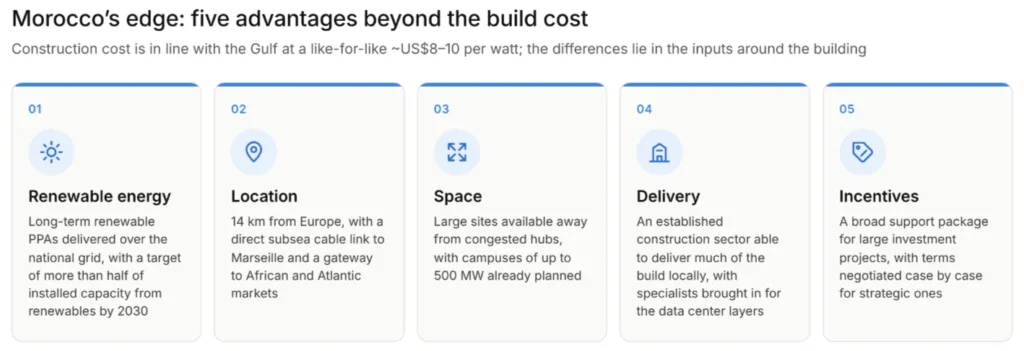
Morocco’s differences lie in the inputs around the building. The first is renewable power. Morocco has been building wind and solar capacity for more than a decade and aims for renewables to make up more than half of its installed power capacity by 2030. Private producers can sell renewable electricity directly to large industrial users under long-term PPAs delivered over the national grid, at regulated and published network charges — an indicative delivered cost of roughly US$45–75 per MWh on AMDIE’s build-up: a US$30–60 generation PPA plus about US$15 of published transmission and system charges. Coal still supplies more than half of the country’s generation, however, so a project’s green credentials depend on contracting renewable supply directly rather than on the grid average.
The second is location and space. Morocco sits 14 km from Europe across the Strait of Gibraltar, and the Medusa subsea cable landed at Nador in December 2025 with a direct link to Marseille. Heavy equipment moves through Tanger Med, Africa’s largest container port (11.1 million TEU in 2025), where well-prepared imports clear customs in 24–48 hours. Space is less of a constraint than in the established hubs, as the 500 MW campus planned at Dakhla shows. The third is delivery and incentives. Our conversations with AMDIE suggest much of the construction work can be delivered locally by established national contractors such as TGCC and SGTM, with foreign expertise needed mainly for the specialist data center layers. Morocco also offers a broad package of support for large investment projects, including relief on imported equipment (customs-duty and VAT exemption for qualifying projects, running 36 months from first import and extendable), streamlined procedures for bringing in foreign specialists (work-contract approvals through the TAECHIR platform, with a stated 10-day response), and direct support under its Investment Charter that can reach 30% of eligible investment, with terms negotiated case by case for strategic projects. For an asset whose budget is dominated by imported equipment, how a project is structured to qualify can make a material difference to its economics.
What comes next. Morocco is still early in its data center journey, and there is work ahead. Site-level feasibility studies, power and grid planning, and building out a specialist supplier and talent ecosystem will all take time, as they did in every hub that came before it. Momentum is building, though. Large AI campuses are already planned near Casablanca, at Tetouan and at Dakhla, and each project that breaks ground will deepen local expertise and bring costs down, just as it did in Lagos and Johor. For AI operators finding the familiar hubs crowded, slow to connect and increasingly expensive, Morocco deserves a place on the shortlist. The builders who look at it now are likely to be the ones who shape the market and the ecosystem as it matures.
What We Watch
For investors in the corridor, four implications follow. First, the cost case is now quantified: a dollar of AI-infrastructure capex buys up to twice the construction in MENA as in Tokyo or Zurich, and the spread is widening. That matters enormously in a sector deploying US$800 billion a year. Second, the real value is in the expertise, not the buildings: the companies that fill MENA’s skills gap (contractors, cooling and power-equipment makers, and specialist delivery teams) stand to gain the most. Many of them are leading Asian firms, and expanding into MENA could be their biggest growth opportunity of the decade. Third, the maturation curve is investable: the Lagos lesson says costs in emerging hubs fall as ecosystems deepen, so early positions in MENA’s data-center supply chain capture both the build-out and the normalization. Fourth, the shortlist is getting longer: as the established hubs ration power and water, markets outside the index, Morocco among them, will compete less on build cost than on power, land and speed of delivery. The first developers to test them will set the benchmarks everyone else uses.
A note on what the numbers measure: Turner & Townsend’s index is a construction cost benchmark. It excludes land, utility connections to site, IT equipment and client direct costs. “Cheaper to build” means exactly that. Power pricing, connectivity and operating economics are separate questions, and in several of them the differences between markets are larger than in construction cost.
GCCVest Partners is a Hong Kong–based, Middle Eastern–backed cross-border asset management firm investing in Asian champions emerging as global leaders while using MENA as a strategic hub for internationalization. For a conversation on the Asia–MENA corridor, please contact our team at info@gccvest.com or visit gccvest.com.
Sources: Turner & Townsend, Data Centre Construction Cost Index 2026–27 (10th edition, 62 markets); prior-year Middle East figures from the 2025–26 edition’s regional release; capex projections cited by the report from PwC. Morocco data: indicative benchmarks shared with GCCVest by the Moroccan Investment and Export Development Agency (AMDIE), gathered through its consultations with market participants and not official national reference figures; Bloomberg (Johor approvals); Morocco World News (renewable targets, Medusa cable).