
By the GCCVest Team — GCCVest Insights Series
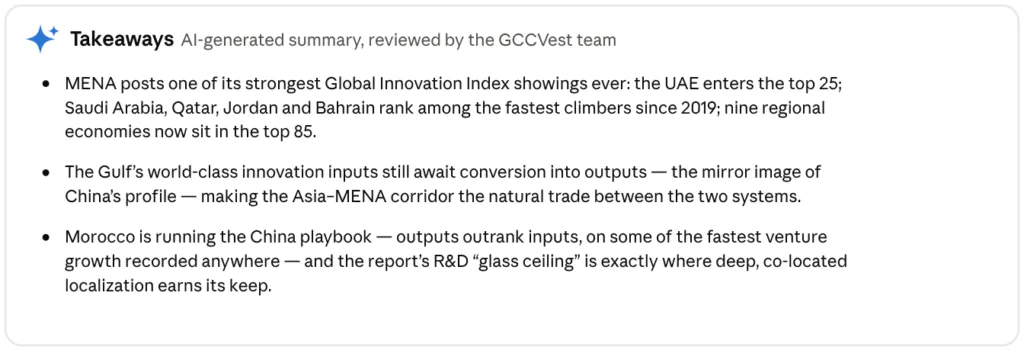
Summary generated with AI assistance and reviewed for accuracy
The World Intellectual Property Organization (WIPO) — the United Nations agency for intellectual property — has just published the Global Innovation Index 2026 (GII 2026) — the world’s most-watched scorecard of national innovation performance, ranking some 130 economies on everything from R&D and venture capital to intellectual property and high-tech exports. Most coverage will dwell on the familiar podium: Switzerland first for a sixteenth consecutive year, Sweden and the United States close behind, China holding 10th as the only middle-income economy among the leaders.
We read it differently. Buried beneath the headline rankings, the GII 2026 quietly documents one of the strongest showings the MENA region has ever recorded — and, read from where GCCVest sits, between Hong Kong and MENA, it reads as independent, third-party validation of the thesis our firm is built on: that the Middle East is becoming not just a buyer of innovation, but a platform for it — and that the fastest way to close the gap the data reveals runs through Asia.
The MENA Scoreboard
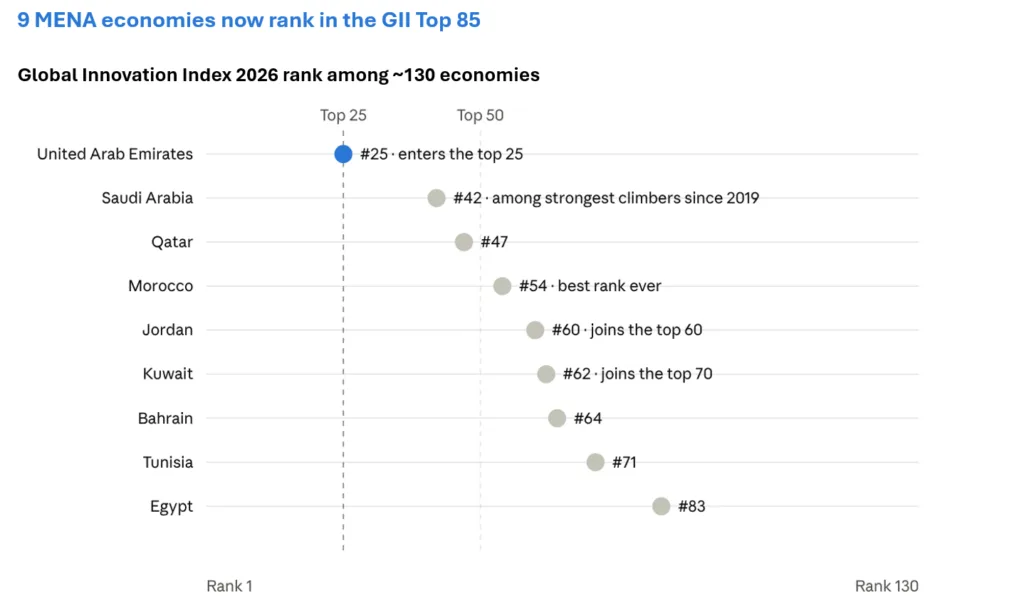
WIPO, Global Innovation Index 2026: Overall ranks of 9 MENA economies
The milestones stack up across the whole region, not just the familiar leaders. The United Arab Emirates enters the GII top 25 for the first time — the only new entrant at that level this year — and ranks among the world’s top 3 destinations for greenfield R&D and high-tech FDI, alongside the United States and India, under a new indicator the GII introduces this year. Saudi Arabia (42nd) records one of the strongest advances of any economy since 2019, ranks first in the world in ICT use, and sees Riyadh enter the global top 100 innovation clusters for the first time. Morocco (54th) reaches its best rank ever and is named by WIPO among the seven middle-income economies worldwide — alongside China, India and Viet Nam — that have climbed furthest since 2013.
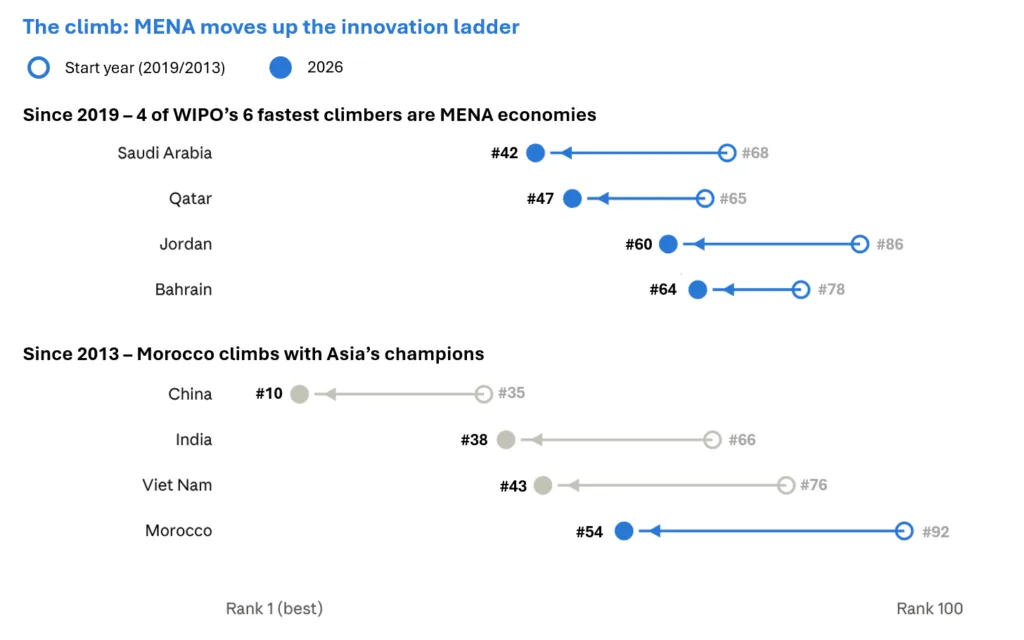
WIPO, GII 2026: Rank changes among the fastest top-70 climbers
The specialist rankings are just as telling. GII indicator ranks measure intensity, not absolute size. They are shares and ratios compared across all 139 economies covered, which is precisely how a smaller economy can lead the world on a specific dimension. Read on those terms: Qatar ranks first globally in tertiary inbound mobility — international students as a share of its university enrollment, a direct measure of talent pull; Bahrain first in ICT access — the index of connectivity infrastructure available across its population; Jordan — newly in the top 60 — first in scientific and technical articles relative to the size of its economy, meaning no economy on Earth publishes more research per dollar of GDP; and Tunisia first in science and engineering graduates as a share of all its university graduates. Egypt plays the scale game instead: a top-100 innovation cluster in Cairo, R&D spending above 1% of GDP — behind only the UAE in the region — and one of the developing world’s largest scientific output bases, at roughly 32,500 articles in 2025. A decade ago, a list of global number-one rankings held by Arab economies — on any definition — would have been a short list indeed.
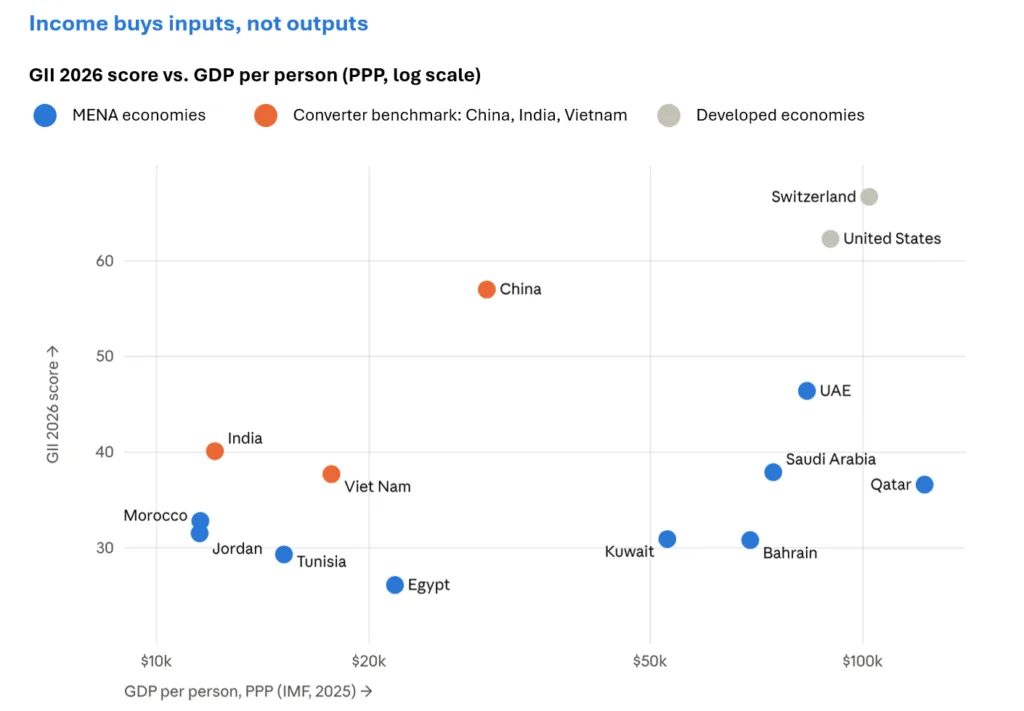
WIPO, GII 2026 and GDP per person: IMF World Economic Outlook (2025), PPP international $, log scale
Three Observations You Can Only Make From the Corridor
1. The Gulf’s “missing half” is exactly what Asia has in surplus. The GII’s most useful analytical lens is the split between innovation inputs (institutions, infrastructure, capital, education) and outputs (patents, products, high-tech exports, creative goods). On that lens, the report makes a pointed observation: Qatar, Saudi Arabia and the UAE show world-class inputs with conversion into outputs as “the necessary next step.” China is the mirror image — the world’s most prominent efficiency outlier, ranking 5th in outputs against 22nd in inputs. Read together, these two findings describe a trade: the Gulf has built the institutions, infrastructure and capital stack of an innovation economy and now needs the conversion engine; China and its Asian peers are the conversion engine and need invited markets and patient capital. That trade is the Asia–MENA corridor. Every Chinese champion localizing a factory, data centre or R&D lab in the Gulf is, in GII terms, importing output-conversion capability into an input-rich system. The index doesn’t name the corridor — but it describes its economic logic almost perfectly.
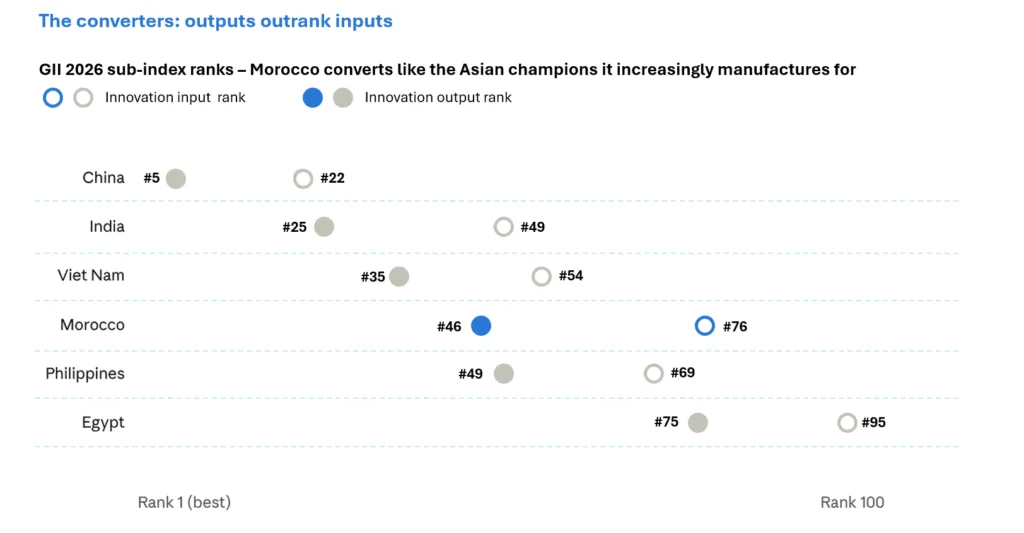
WIPO, GII 2026: Innovation input and output sub-index ranks
2. Morocco is quietly running the China playbook — and the venture data proves it. WIPO places Morocco in the small club of middle-income economies that have climbed furthest since 2013, alongside China, India and VietNam — and for the same structural reason: it converts more than it consumes, ranking 76th in inputs but 46th in outputs, on the strength of industrial design, trademarks and high-tech manufacturing. The report’s venture capital chapter adds the sharpest single data point in the region: Morocco has grown VC deal counts at a 39% annualized rate over 5 years — among the fastest expansions recorded anywhere, and one strand of a venture acceleration running across the region. For readers of our earlier piece on Chinese enterprises localizing in MENA, this is the statistical backbone of the “Morocco playbook”: a GCC headquarters paired with North African manufacturing is no longer a logistics arbitrage — it places you inside one of the world’s fastest-improving innovation economies, with duty-free reach into Europe and the US.

3. The “glass ceiling” the GII warns about is precisely where cross-border partnership earns its keep. The report’s most sobering finding is that middle-income convergence has been easiest in production, exports, startup finance and IP registration — and hardest in the knowledge base and R&D, “where research capacity builds slowly.” That is the ceiling every national vision in our region will eventually hit if it relies on capital alone. It is also, not coincidentally, the exact gap we flagged in our localization work: technology transfer without living, in-market R&D is a wasting asset. The economies that break the ceiling will be those that import not licences but laboratories — co-located engineering teams, joint innovation labs, and the patient science–industry linkages the GII says cannot be bought quickly. The Gulf has the balance sheet to compress that timeline; Asia has the research-intensive champions willing to co-build. Neither breaks the ceiling alone.
The Next Frontier: Deep Science

The report’s special theme deserves its own note, because it points directly at the corridor’s next chapter. Deep-science ventures — semiconductors, robotics, space, energy, life sciences — are capital-intensive by definition: years separate invention from first sale, and patents are often the only bankable asset in between. That profile is tailor-made for Gulf balance sheets and patient sovereign capital. The talent linkage runs through the same plumbing this series keeps returning to: over 40% of deep-science startups trace their origins to universities, which makes the region’s first-place rankings in inbound students and engineering graduates considerably more than trivia. MENA’s footprint in the tracker is still early — Egypt’s Mogassam already tops its national deep-science patent ranking — and mapping the region’s full cohort is a piece we will return to. The signal, for now: the defining constraint of the next startup wave is capital with patience, and no region holds more of it.
What This Means for How We Invest
GCCVest was built on a specific thesis: invest in Asian champions emerging as global leaders, and help them use MENA as a strategic hub for internationalization. The GII 2026 is the most comprehensive independent dataset yet assembled in support of that thesis, and it sharpens it in three ways.
First, the destination is validated. When the UAE sits among the world’s top three magnets for greenfield R&D and high-tech FDI, when Riyadh and Cairo hold top-100 innovation clusters, and when the region collects first-place global rankings in ICT use, ICT access, inbound students, scientific articles and engineering graduates, MENA is no longer an “emerging” story that requires persuading — it is a measured one. The question for an Asian champion is no longer whether the region is ready, but who can navigate it.
Second, the direction of value creation is confirmed. The input–output asymmetry — Gulf inputs seeking conversion, Asian outputs seeking markets — is the single clearest economic argument for the corridor we have seen in print. Our portfolio approach follows it directly: we back companies whose output engines — manufacturing discipline, product velocity, deployment speed — are precisely what input-rich MENA systems need, and we structure their entry so that capability genuinely lands in-market.
Third, the timeline is honest. The GII’s glass-ceiling warning is a reminder that rankings can plateau. The national visions driving this ascent are multi-decade commitments, and the hard part — research capacity, science–industry linkages — is still ahead. That is not a caution against the corridor; it is the strongest argument for the kind of deep, R&D-anchored localization we help structure, rather than the transactional trade the region is outgrowing.
A decade of GII editions tells one story about MENA: the inputs are built. The next decade will be decided by conversion — and conversion is a partnership business. Corridors, as we like to say, are built on trust before they are built on term sheets. The 2026 index suggests the term sheets now have a great deal to work with.
GCCVest Partners is a Hong Kong–based, Middle Eastern–backed cross-border asset management firm investing in Asian champions emerging as global leaders while using MENA as a strategic hub for internationalisation. For a conversation on the Asia–MENA corridor, please contact our team at info@gccvest.com or visit gccvest.com.
Source: WIPO, Global Innovation Index 2026 — “Powering Entrepreneurs at the Frontier of Science.”