
Hong Kong, September 2026 — GCCVest Founder and Managing Partner Ben Jelloun joined policymakers and senior financiers on the Main Forum stage of the 11th Belt and Road Summit at the Hong Kong Convention and Exhibition Centre, speaking in the thematic session “Capital and Connectivity Across a Realigning World”, co-organised by Bank of China (Hong Kong) and the Financial Services Development Council (FSDC).
Now in its eleventh year, the Summit convenes government leaders, multilateral institutions and business decision-makers from across the Belt and Road economies. This year’s edition — themed Advancing High-Quality Development • Embarking on a New Journey — came at a telling moment: cumulative Belt and Road engagement has surpassed US$1.4 trillion since 2013, with 2025 a record year at over US$214 billion across some 350 deals. The question running through the Summit was no longer whether capital moves across the corridor, but how those flows become scalable, private-sector-led and durable.
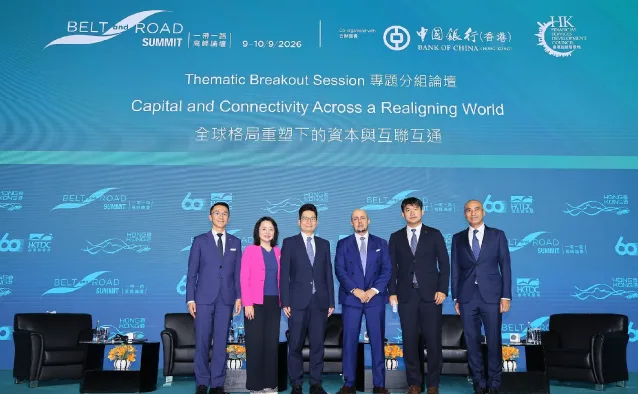
Panellists of “Capital and Connectivity Across a Realigning World” at the 11th Belt and Road Summit, HKCEC, 10 September 2026 — including GCCVest’s Ben Jelloun, HKSAR Under Secretary for Financial Services and the Treasury Joseph Chan, panel chair Jennifer Tan, and fellow speakers from Bank of China (Hong Kong), the FSDC and CT Bright Group.
On Stage: Growth Without Borders
The session opened with remarks by Mr Wang Huabin, Deputy Chief Executive of Bank of China (Hong Kong), followed by the launch of the FSDC’s new report, Catalysing Regional Connectivity: Hong Kong as the Nexus Where Capital Anchors and Flows, presented by FSDC Executive Director Dr Rocky Tung.
The main panel, “Growth Without Borders — Aligning Opportunity and Capital Across the Belt and Road”, was chaired by Ms Jennifer Tan, FSDC Board Member and Senior Advisor at Ant Digital Technologies. Ben shared the stage with Mr Joseph Chan, JP, Under Secretary for Financial Services and the Treasury of the HKSAR Government; Mr Liu Xun, Deputy General Manager, Global Corporate Banking Department, Bank of China (Hong Kong); and Dr Ngai Lung, Senior Vice President of CT Bright Group and FSDC ASEAN Advisory Group Member.
As the panel’s voice on the Middle East, Ben was asked to address the question at the heart of GCCVest’s mandate: what it actually takes — on governance, technology transfer, board
representation and local ownership — for Gulf capital to build durable exposure in Asia, and for Asian industrial champions to localise successfully in the GCC.
Alignment, Not Concession
Ben’s first intervention reframed the debate. The Asia–MENA corridor is often described as a negotiation over what each side must give up. In his view, the deals that endure are built differently: on honest alignment of ambition before any term sheet is drafted. Some companies internationalise to restructure ownership and preserve market access; listed champions need control to consolidate a joint venture into their capital markets story; others want IP licensing with minimal capital at risk. There is no single template — and pretending there is one is where most cross-border partnerships fail.
He illustrated the point with a joint venture GCCVest structured in the Middle East between a Chinese industrial player and a local partner. The equity was 50/50, but effective control was allocated through governance rather than the cap table: the Chinese side appointed the CEO and ran operations and manufacturing; the local partner appointed the CFO and led every function requiring engagement with local authorities — regulation, government relations, hiring and distribution. “Design governance around capability, not symbolic parity,” he told the audience.
On technology transfer, Ben challenged a common obsession: months spent valuing and ring-fencing IP that, in fast-moving sectors, depreciates almost as quickly as it is transferred. The meaningful commitment is not the licence but the co-location of genuine R&D capability that can innovate, upgrade and maintain the technology in-market.
And on boards, he shared an observation drawn from meeting more than two hundred listed companies across China: their boards remain almost uniformly local, in contrast to the more internationally diversified boards common in the US — and, notably, in the Middle East, where a deep expatriate professional class has long shaped governance. Where the two regions genuinely mirror each other is concentrated family ownership — which is why, in his experience, joint ventures succeed when the principals meet early, and stall when the dialogue is left to intermediaries.
From Sovereign Handshakes to a Firm-to-Firm Corridor
Asked which structural change will most reshape Asia–Gulf commercial ties over the next five years, Ben pointed to a transition already underway: the corridor is moving from government-to-government to firm-to-firm.
The sovereign phase worked. China attracted over US$10 billion from state-owned investors in 2024, more than 60 percent of it from Gulf funds, and Gulf sovereign wealth funds — which now manage close to US$6 trillion, over 40 percent of the global total — directed roughly 40 percent of their 2025 deployment toward Asia. But the next wave is different in kind: Chinese industrial champions physically localising capacity in the Gulf — factories, data centres, R&D — and Gulf private capital, family offices and mid-sized institutions following the sovereigns into Asia for the first time. Meituan’s Keeta choosing Riyadh for its international debut, and the billion-dollar-plus commitments of China’s major cloud providers to Saudi Arabia, are early markers of that shift.
A sovereign-to-sovereign deal, Ben noted, needs a phone call and a signing ceremony. A thousand firm-to-firm deals need infrastructure — and that is where the corridor’s plumbing remains unfinished:
- Fund recognition. Virtually every Asia–MENA fund today is a Cayman vehicle managed from Hong Kong. What is missing is a mutual recognition of funds arrangement between the SFC and Gulf regulators — even a narrow passporting regime for professional investors would collapse months of friction into weeks.
- Cross-listed products. The pipe furthest along: the ETF link between Hong Kong and Saudi Arabia’s Tadawul has already produced the largest ETF in the Middle East, with exposure now chaining onward into mainland China. The recognition framework for secondary corporate listings exists — the corporates must now follow the products.
- Shariah-compliant structures. Hong Kong’s first Saudi sukuk ETF is a start, but a genuine Shariah wrapper ecosystem — screens, boards, documentation, tax treatment — would unlock the deepest untapped pool in the corridor: Islamic institutional capital.
- Talent. The scarcest resource is neither capital nor deal flow, but professionals who can operate in both systems. Teams that combine native Mandarin and Arabic speakers — a founding principle at GCCVest — remain the exception, not the rule.
- Enforcement and payments. The unglamorous layer practitioners feel most: cross-border receivables and correspondent banking friction still tax every small and mid-sized participant — precisely the firms the next wave is made of.
Where Hong Kong Does Real Work
Speaking in the city where GCCVest is headquartered, Ben offered an observation that resonated with the room: across dozens of cross-border transactions, no counterparty has ever objected to Hong Kong law. Its courts and arbitration are widely accepted as well-developed and fair — with an advantage no other seat offers: mutual enforcement arrangements with the Chinese mainland.
The neutral jurisdiction earns its keep at the fund and holding level, where a Saudi family office, a Chinese GP and an international auditor can coexist within one recognised structure. But Ben added a practitioner’s contrarian note: for the operating joint venture itself, GCCVest often prefers local jurisdiction. Localising seriously means being enforceable and credible in the market where you operate. The neutral hub should hold the capital structure — it should never be a device for keeping presence thin.
His test for when the corridor has truly matured is simple: when a mid-sized Saudi family office can subscribe to a Hong Kong-domiciled fund from a Hong Kong-licensed manager — without a Cayman detour and without a local wrapper — the plumbing is done.
The session closed with a shared conviction across the panel: the realignment of global capital is not a headwind for the Belt and Road economies but the very force pulling the Gulf and Asia closer together — and Hong Kong sits at the point where those flows anchor.
The full session is available for replay on the Belt and Road Summit website.
About GCCVest
GCCVest Partners is a Hong Kong–based, Middle Eastern–backed cross-border asset management firm investing in Asian champions emerging as global leaders while using MENA as a strategic hub for internationalisation. With teams native in Mandarin and Arabic and a track record spanning fund management, joint-venture structuring and cross-border advisory, GCCVest bridges capital, capability and trust across the Asia–MENA corridor. Ben Jelloun serves on the Middle East Advisory Group of Hong Kong’s Financial Services Development Council.
For partnership or media enquiries, please contact the GCCVest team.